
This article describes how the output in roller compaction can be increased and compares it to wet granulation.
After a successful development phase, it is time to scale-up to larger batch sizes. Going from the first clinical batches to production-sized batches often poses questions like ‘what equipment is needed’ and ‘what are the risks in scale-up’. Below is an overview of the scale-up strategies for roller compaction.
Scale-Up by Production Time
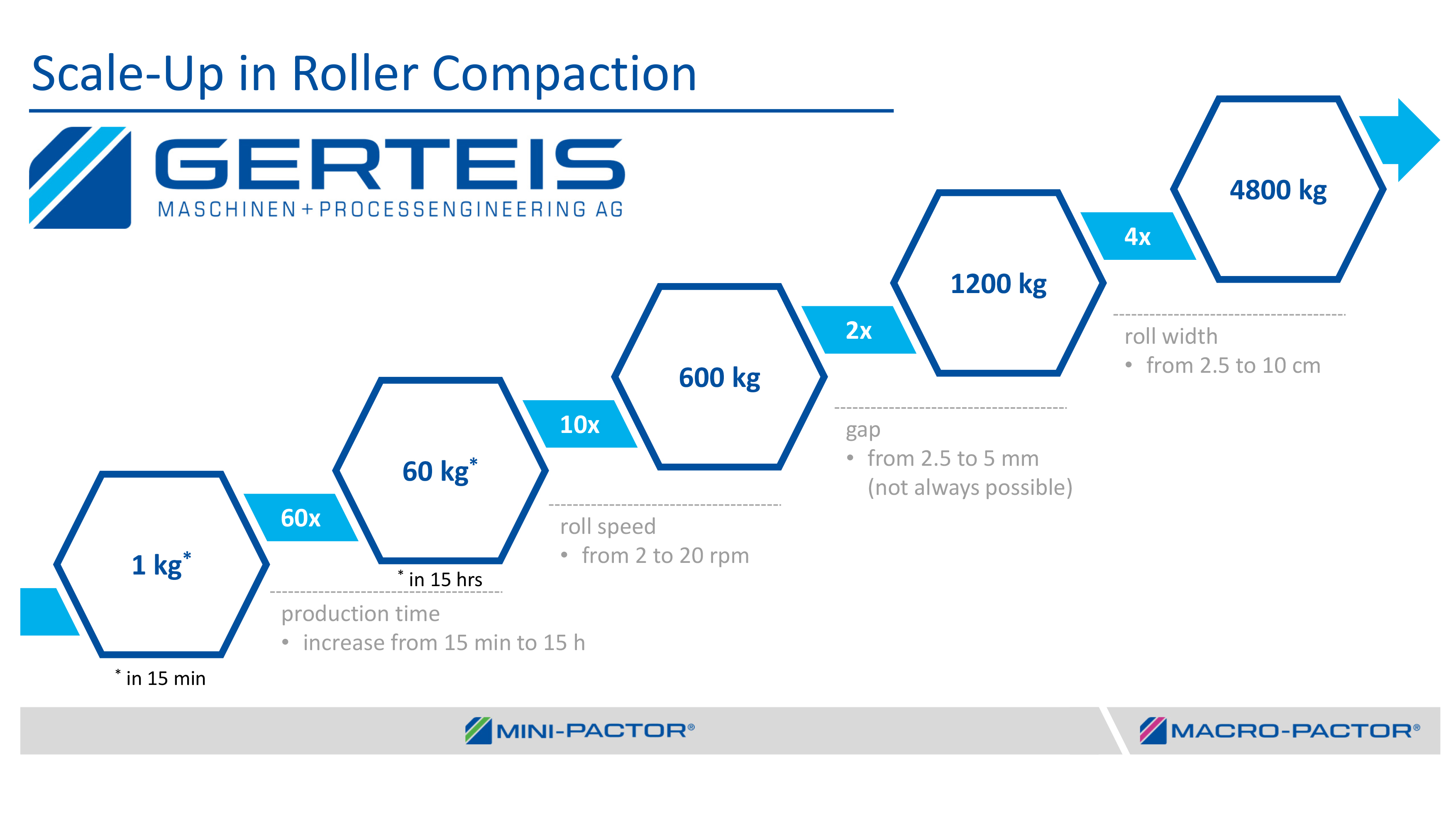
A common batch size for R&D is approx. 1 kg. On the MINI-PACTOR®, a lab-scale roller compactor, this can be produced in approximately 15 minutes with a slow roll speed of 2 rpm. This being a continuous manufacturing process, the easiest way to increase the batch size is to extend the production time. No other production parameters must be adapted and thus the product quality will remain constant. When extending the production time from 15 minutes to 15 hours for example, the batch size can increase from the initially assumed 1 kg to 60 kg. This results in a scale-up factor of 60 without changing the settings of the roller compactor. It stands to reason then that other scale-up factors are also possible by simply adjusting the production time based on desired batch sizes.
Scale-Up by Roll Speed
The second easily changeable parameter is the roll speed. During R&D work, slower roll speeds such as 2 rpm are typically used because the API is rare and only small batches are required. Increasing the roll speed often requires little to no adaptations to the roller compaction settings to gain the same granulate quality. The reason for this is that roller compaction is a slow densification process, especially compared to rotary tableting. Only at high speeds of about 30 rpm will the overall densification time be comparable to that of rotary tablet presses. When leaving out these high speeds, an increase of roll speed from 2 rpm to 20 rpm increases the throughput by a factor 10. This means our starting batch of 1 kg in 15 min can be increased to 10 kg in 15 min. Combining these two strategies, ‘production time’ and ‘roll speed’, a scale-up factor of 600 is easily possible without changing the equipment. In our example this means 600 kg in 15 hours.
Scale-Up by Gap
Another possibility to increase the throughput and therefore the producible batch size in a certain time is to increase the gap. Doubling the gap from 2.5 mm in R&D to 5 mm in production means to increase the throughput by a factor of 2. For achieving the same ribbon quality, the at-gap density must stay the same. Consequently, for a larger gap the mass being manufactured through this gap must increase by the same factor. Please be aware that increasing the gap is not as easy as increasing the production time or roll speed. A change of gap generally leads to a change in the at-gap density. Therefore, an adjustment of the specific roll force must be made to achieve the same ribbon density and a constant granulate quality. Additionally, enlarging the gap is not always possible. For example, this might not be feasible for products that suffer from draw-in issues.
Scale-Up by Roll Width
For the three activities of scale-up described above, (assuming that the product allows for increasing the gap), no change of equipment is necessary.
Generally, R&D is performed on a MINI-PACTOR® which has 2.5 cm wide rolls. By changing this machine to a production machine, a MACRO-PACTOR® having 10 cm wide rolls, a factor of 4 times more material can be manufactured in the same amount of time. Design and the performance of both machines are engineered in such a way that a product transfer from the MINI-PACTOR® to the MACRO-PACTOR® is straightforward and easily accomplished.
Overall Scale-Up Factor
For a reasonable overall scale-up factor in roller compaction, the extreme settings should be omitted as the previously given examples already did. Without changing the equipment, a scale-up factor of 600 is achievable (increase of production time and roll speed, Figure 1). Often it can even be twice as large by doubling the gap. But please be aware that this is not always possible. By changing the equipment from MINI-PACTOR® to MACRO-PACTOR®, the scale-up factor can be enlarged to 2400 or even 4800 if increasing the gap is possible.
Comparison to Wet Granulation
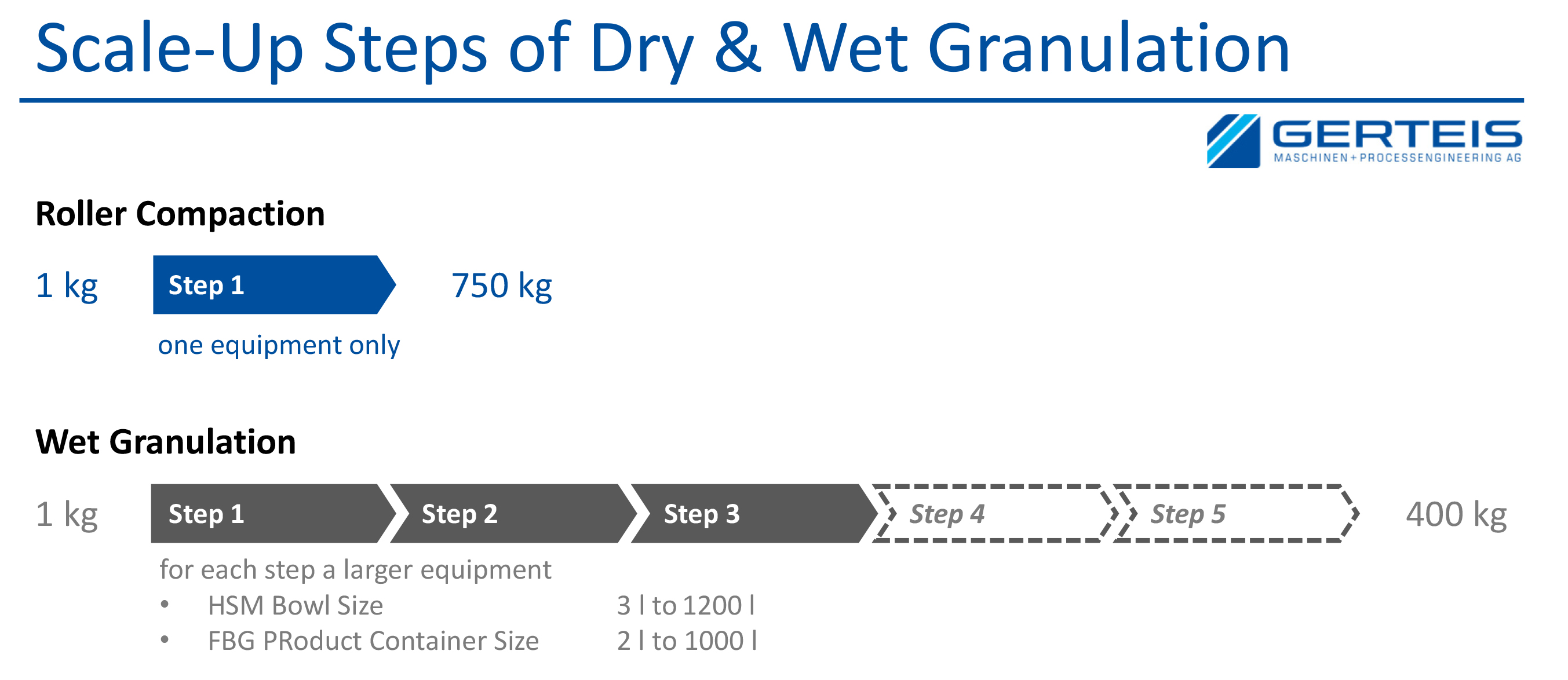
In wet granulation, a common production batch size is 400 kg. This requires high shear mixing (HSM) an approx. 1200 liter bowl or for fluid bed granulation (FBG) approx. a 1000 liter product container. The R&D work for both of these wet granulation technologies is typically done with smaller-scale 1 kg batches. Scaling up this 1 kg R&D batch to a production sized batch requires at least 3 scale-up steps, but more likely 5 (Figure 2). Each of these steps is executed using different (increasingly larger) equipment. Additionally, the scale-up transitions are more complex. A lot of influencing factors are identified, but they are difficult to predict when transferring to the next bowl or container size.
Conclusion
In roller compaction, a scale-up factor of 600 is easily achievable using the same equipment. Including for a change to a production-sized machine, the scale-up factor increases to 2400 or more. In general, only 1 step is needed for scale-up. In contrast to the straightforward scale-up in roller compaction, wet granulation needs several steps with different equipment, resulting in a scale-up factor of only 400.